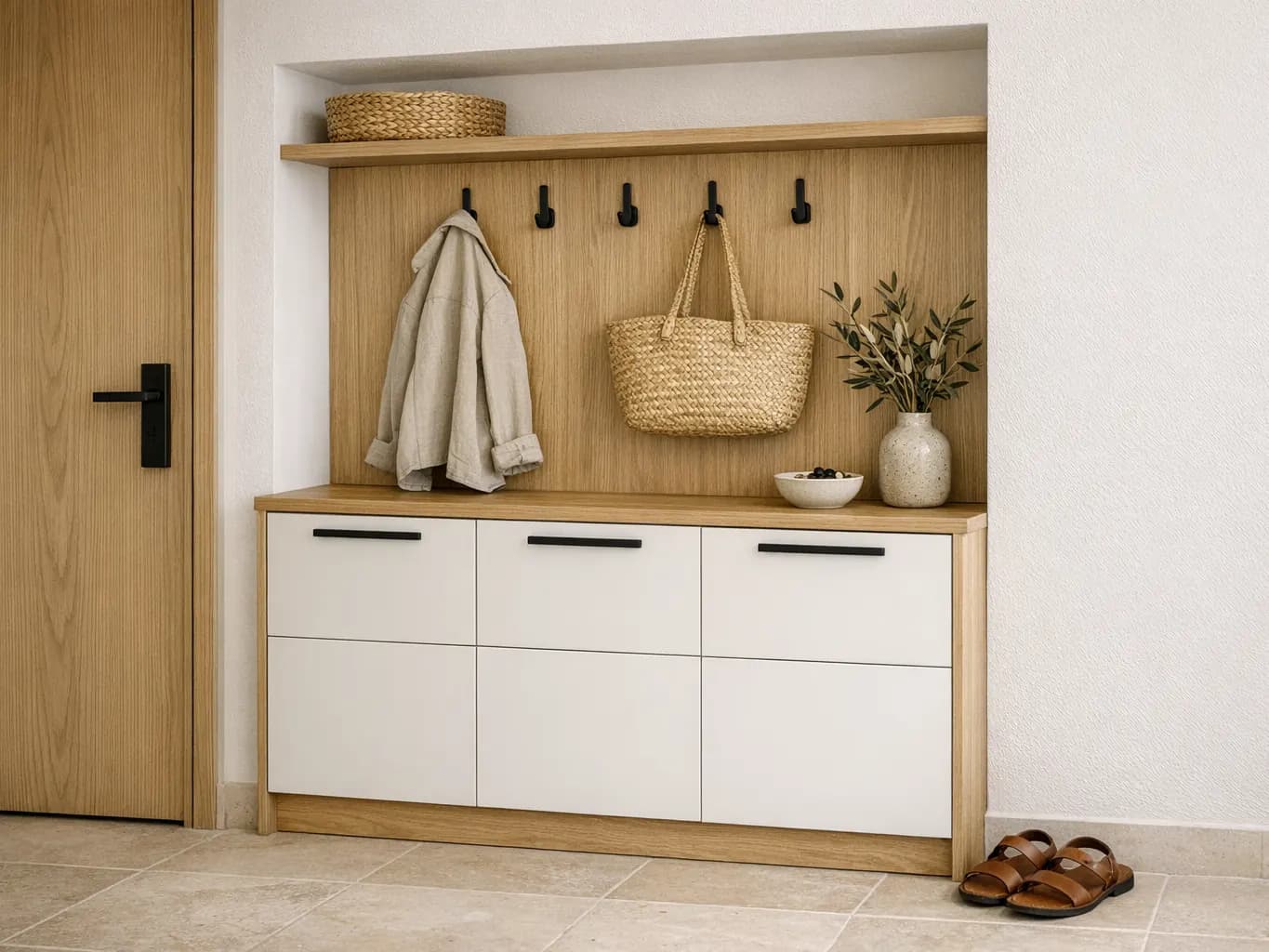
Hallway furniture for the space by the door
In many Cypriot apartments the front door opens straight into the living room, and the only place for shoes is a strip of wall beside it, a niche behind the door, or the space under the stairs in a house. A family of four easily has thirty pairs, and summer brings sand in with every one. A shop cabinet comes 60 or 80 cm wide; a shoe cabinet made to measure takes the whole strip, from the door frame to the corner, and as high as you like.
How deep a shoe cabinet needs to be
Slim cabinets from shops, 17–25 cm deep, use tilting compartments. The designer draws shelves behind doors, which hold more and fit boots, but need room: plan 30–35 cm of depth so adult shoes lie flat.
Depth, shoes flat on shelves
Usual size: 30–35 cm
Shelf spacing, shoes and trainers
Usual size: 15–20 cm
Shelf spacing, boots
Usual size: 35–45 cm
Height to put keys on top
Usual size: 90–100 cm
Tall hallway cupboard with a hanging rail
Usual size: 60 cm deep
| Usual size | |
|---|---|
| Depth, shoes flat on shelves | 30–35 cm |
| Shelf spacing, shoes and trainers | 15–20 cm |
| Shelf spacing, boots | 35–45 cm |
| Height to put keys on top | 90–100 cm |
| Tall hallway cupboard with a hanging rail | 60 cm deep |
A whole hallway unit
If the hallway allows, draw a low shoe cabinet with a tall cupboard next to it for coats, bags and the vacuum cleaner. Coats on hangers need about 60 cm of depth; in a narrow hallway keep the cabinet shallow and put hooks on the wall above it. Both pieces go in the same design, in one colour, with one price.
Small things that matter by the door
- Check the swing of the front door and its handle, so the cabinet does not block it
- Shoes need air: ask the workshop for a gap under the doors or a few holes in the back
- A cabinet taller than it is deep is fixed to the wall; the designer marks it
- Near the sea, sand and damp shoes are hard on raw edges — every visible edge is banded in ABS
Materials
The cabinet is 18 mm melamine-faced chipboard, the back 3 mm board, ABS edging, soft-close hinges. Melamine wipes clean, which is what you want where wet shoes stand.
How ordering works
- Measure the wall or niche and start from the shoe cabinet template, or describe it: “shoe cabinet 1.4 m wide, 1 m high, two doors”.
- Set the width, height, depth, shelves, doors and colour. The estimated price follows.
- Send the design. A partner workshop checks it, measures, confirms the final price and makes it — delivered and assembled, delivered flat, or collected. You pay the workshop directly.
What to measure
The free width of the wall or niche, the depth you can spare without blocking the way, the height up to any switch, intercom or electricity board, and the depth of the skirting board.
Made to measure or ready-made
A slim tilt-out shoe cabinet from a shop is cheap and fits where nothing else does — at 20 cm deep it is often the right answer in a narrow corridor. Made to measure is for when you have a niche or a wall to fill and want everything, including boots and the coats, in one piece.