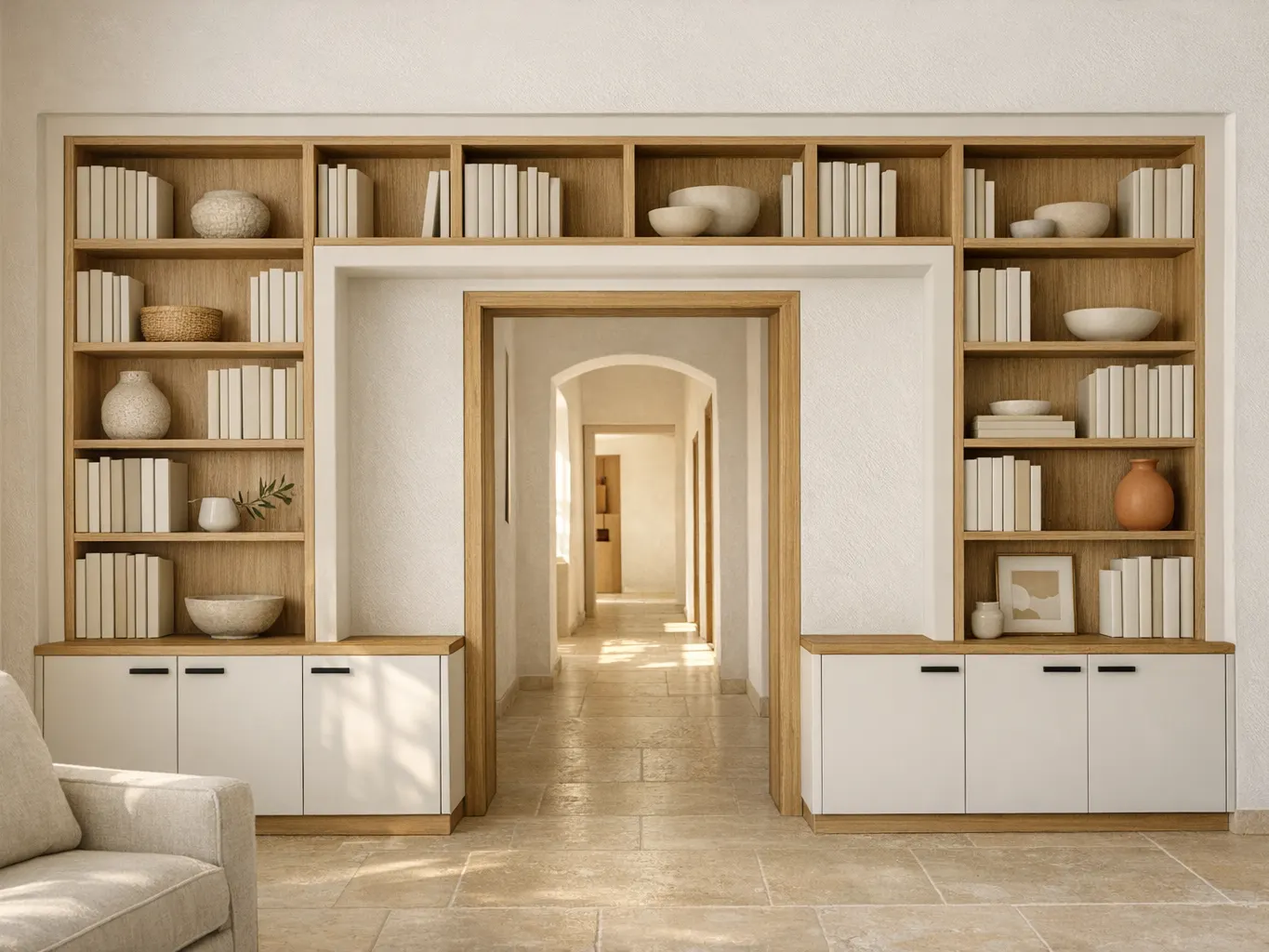
Shelving for a niche, a wall, or around a door
Cypriot houses and apartments are full of spaces that a shop bookcase never quite fits: the niche beside a fireplace, the alcove left by a column, a wall in the study with a door in the middle of it. A built-in bookcase made to measure goes from wall to wall and up to the ceiling, with the columns spaced for what you keep — books, files, toys or a vinyl collection.
Why shelves sag, and how wide they can be
Books are heavy. An 18 mm shelf loaded with them bends a little at first, then a little more each year, until the middle of the shelf visibly dips. The designer checks every shelf against the load you choose and warns you when a span is too wide. For books, plan a column or divider every 80–90 cm; for light things a shelf can be wider. It is the most common mistake in home-made shelving, and the cheapest to avoid on paper.
Depth for paperbacks
Usual size: 25 cm
Depth for large books, files, boxes
Usual size: 30–35 cm
Shelf spacing for most books
Usual size: 28–35 cm
Column width for books
Usual size: up to 80–90 cm
Height
Usual size: to the ceiling, fixed to the wall
| Usual size | |
|---|---|
| Depth for paperbacks | 25 cm |
| Depth for large books, files, boxes | 30–35 cm |
| Shelf spacing for most books | 28–35 cm |
| Column width for books | up to 80–90 cm |
| Height | to the ceiling, fixed to the wall |
Open, closed, or both
A common plan is doors on the lower part, for things you would rather not see, and open shelves above at eye level. Each column in the designer can be open, have doors or drawers, so the split is yours. A bookcase without handles keeps the front plain.
Around a door or a window
Shelving that frames a door is two tall columns and a shelf unit over the top. Draw the pieces side by side on one wall in the designer; the workshop joins them into one and checks the door frame at the measuring. The same works under and around a window.
Materials and fixing
Carcass and shelves are 18 mm melamine-faced chipboard, the back 3 mm board, visible edges banded in ABS. Tall bookcases are always fixed to the wall — the designer marks them — which matters with children who climb and with the odd earthquake tremor. Shelves sit on shelf pins; ask the workshop for a row of holes if you want to move them later.
How ordering works
- Measure the wall or niche and start from the bookcase template, or describe it: “bookcase for the whole wall, 3.1 m, doors below”.
- Set columns, shelves, doors and colour. Watch the shelf warnings and the estimated price as you go.
- Send the design. A partner workshop checks it, measures, confirms the final price and makes it — delivered and assembled, delivered flat, or collected. You pay the workshop directly.
What to measure
Width at the top and the floor, height at both ends, the skirting board, sockets and switches on the wall, and the door or window frame if the shelving goes around it.
Made to measure or IKEA BILLY
BILLY and KALLAX are cheap, sturdy enough, and easy to replace. Several of them in a row still leave gaps at the sides and above. Made to measure fills the wall, follows the ceiling, and gets fixed by the people who built it. If the wall is a standard width, the shop shelves may be the better buy.