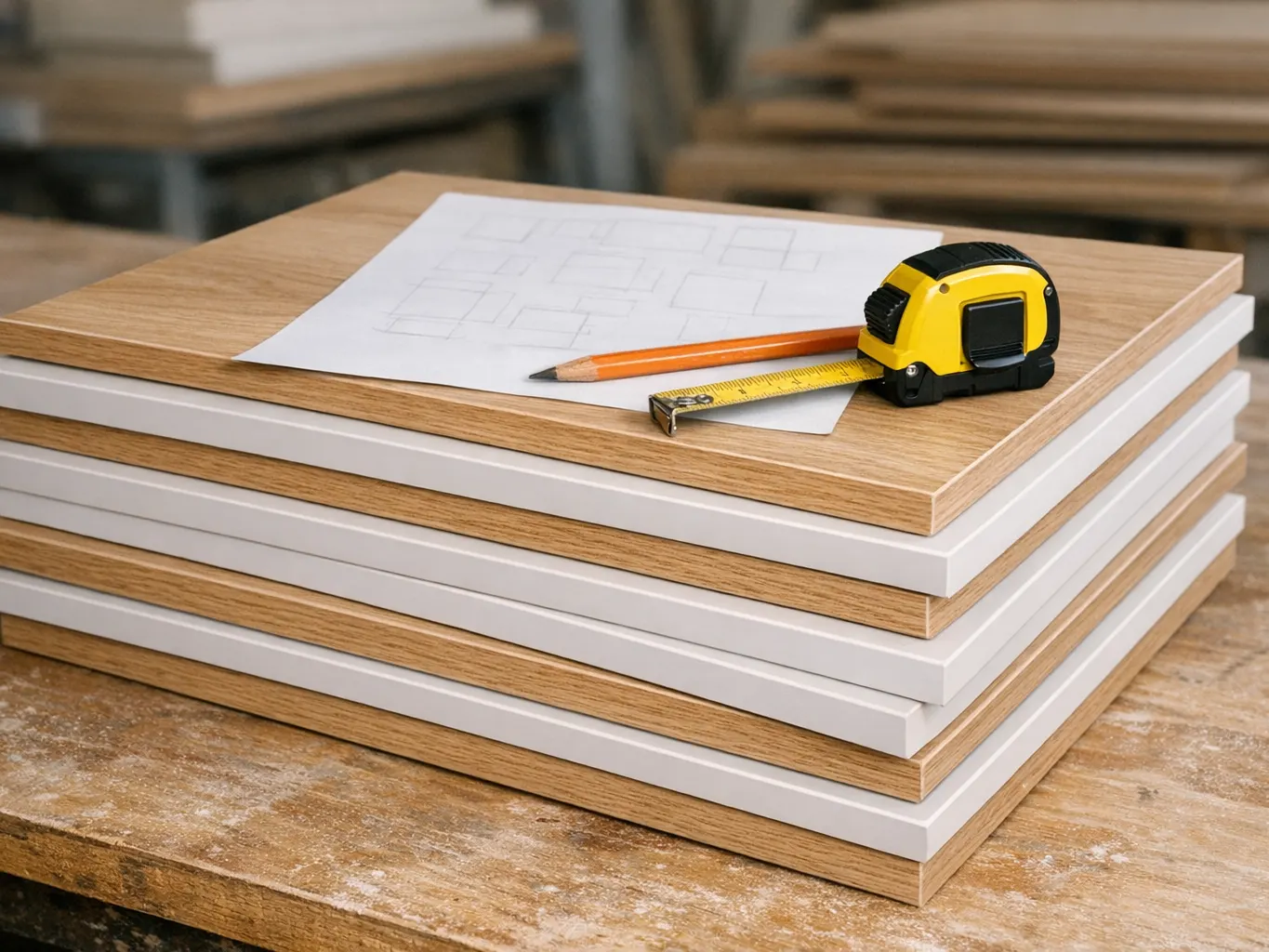
What each board is
Melamine-faced chipboard, MFC for short, is chipboard — wood chips pressed with resin — with a decor paper soaked in melamine resin pressed onto both faces at the factory. The surface is finished before the board leaves the factory: plain colours, woodgrains, matt or textured. The cut edges are raw chipboard and are covered with edging, usually ABS, in a matching colour.
MDF is made of fine wood fibres pressed with resin into a dense, even board. It has no coarse core, so it can be routed, rounded and painted, and the edge can be sanded and lacquered like the face. Raw MDF is grey-brown and is painted or lacquered; it is also sold faced with melamine like chipboard, and then behaves much like MFC with a better core.
Side by side
Surface
Melamine-faced chipboard: Finished at the factory, hard-wearing
MDF: Needs paint or lacquer, or a melamine face
Colours
Melamine-faced chipboard: The board range: many plain colours and woodgrains
MDF: Any paint colour, gloss to matt
Edges
Melamine-faced chipboard: Covered with ABS edging; a thin line shows
MDF: Can be painted with the face, no line
Shapes
Melamine-faced chipboard: Straight cuts and drilling
MDF: Routed profiles, curves, handleless grooves
Bending strength (EN minimum, 13–20 mm)
Melamine-faced chipboard: 11 N/mm²
MDF: 23 N/mm²
Stiffness (EN minimum, 13–20 mm)
Melamine-faced chipboard: 1600 N/mm²
MDF: 2200 N/mm²
Screws in the edge
Melamine-faced chipboard: Holds with the right fixings (confirmat, cams, dowels)
MDF: Holds better
Weight
Melamine-faced chipboard: Lighter
MDF: Heavier
Price
Melamine-faced chipboard: Lower
MDF: Higher, and paint adds again
| Melamine-faced chipboard | MDF | |
|---|---|---|
| Surface | Finished at the factory, hard-wearing | Needs paint or lacquer, or a melamine face |
| Colours | The board range: many plain colours and woodgrains | Any paint colour, gloss to matt |
| Edges | Covered with ABS edging; a thin line shows | Can be painted with the face, no line |
| Shapes | Straight cuts and drilling | Routed profiles, curves, handleless grooves |
| Bending strength (EN minimum, 13–20 mm) | 11 N/mm² | 23 N/mm² |
| Stiffness (EN minimum, 13–20 mm) | 1600 N/mm² | 2200 N/mm² |
| Screws in the edge | Holds with the right fixings (confirmat, cams, dowels) | Holds better |
| Weight | Lighter | Heavier |
| Price | Lower | Higher, and paint adds again |
The strength figures are the minimums the European standards set for general-purpose boards (chipboard P2 under EN 312, MDF under EN 622-5), taken from a manufacturer's data sheets. Real boards are usually stronger, but the ratio holds: MDF is stiffer and stronger than chipboard of the same thickness.
Shelves and sag
Stiffness matters for shelves. An 18 mm melamine shelf of normal length carries folded clothes without trouble; a long shelf loaded with books will bow over months. You can shorten the span with a divider, use a thicker board, or fix the shelf at both ends instead of resting it on pins. The Epiplana designer checks every shelf against its length and what it is for, and tells you when one is too long.
Fronts: where MDF earns its price
If you want a painted kitchen, a front with a routed frame, rounded edges or a groove to open it without handles, that is MDF. If you want a woodgrain or a plain colour that will not chip, needs no painter and costs less, that is melamine. Many kitchens and wardrobes mix the two: melamine carcasses and shelves, MDF doors.
Water in kitchens and bathrooms
Neither board likes water at a raw edge. Chipboard swells where water gets into an unsealed cut or a drill hole, and MDF swells too, a little more slowly. What protects both is sealed edges — edging glued all round — and silicone around sink and hob cut-outs. Moisture-resistant grades of both boards exist, often with a green-dyed core, and are worth asking about for a sink unit or a bathroom.
Formaldehyde
Both boards are bonded with resins. Since 6 August 2026 an EU rule limits the formaldehyde that furniture and wood-based panels may give off to 0.062 mg/m³, half the old E1 level. It applies to chipboard and MDF alike, so the choice between them does not change it; ask the workshop for boards declared to the new limit.
What Epiplana uses
Epiplana furniture is made from 18 mm melamine-faced chipboard for carcasses, shelves and doors, 3 mm board for backs and drawer bottoms, ABS edging all round, and soft-close hinges and runners. Melamine gives a finished surface without painting, a wide choice of colours and woodgrains, and the best price for the size. Painted or lacquered MDF doors are not in the designer; if you want them, tell the workshop when it gets in touch about your design.